Hydrological Services
Namibia's water resources: rivers, dams, groundwater, desalination, recycling and evaporation.
Water as a Natural Resource
Of the rain that falls in Namibia, 83% evaporates, 14% is lost through transpiration, 2% runs off in rivers and 1% seeps underground, where it may later be abstracted through boreholes. Namibia's water sources are border rivers, dams on ephemeral rivers, groundwater, fountains, seawater desalination and recycled water.
Article 95(1) of the Constitution provides for the use of living natural resources on a sustainable basis for the benefit of all Namibians, present and future. Article 100 states that land, water and natural resources belong to the State.
Water Resources
Namibia is the driest country in Africa south of the Sahara. Annual rainfall ranges from 550 mm to 600 mm in the far north to between 250 mm and 300 mm in the south. The central area, including Windhoek, receives 450 mm to 500 mm a year. The Cuvelai in the north, which extends to the border with Angola, receives 250 mm to 350 mm. The east, which includes the Kalahari Desert, receives 50 mm to 250 mm, and the coastal desert from Oranjemund to the Kunene receives less than 50 mm.
Border Rivers
Namibia has five perennial rivers and about 20 well-defined ephemeral rivers. The perennial rivers are:
- The Orange River in the south
- The Kunene River in the north
- The Kavango River in the far north
- The Zambezi River in the far north
- The Kwando (Linyanti or Chobe) River in the far north
The Zambezi and Kwando rivers flow into the Indian Ocean, while the Kavango River flows into the Okavango Delta.
Ephemeral Rivers
The Ugab, Omaruru, Swakop, Khan, Kuiseb, Fish, Nossob and Hoanib rivers flow towards the Atlantic Ocean. The Tsauchab River flows into Sossusvlei, while the Ekuma and Oshigambo rivers flow into the endorheic basin of the Etosha Pan.
Namibia's Dams
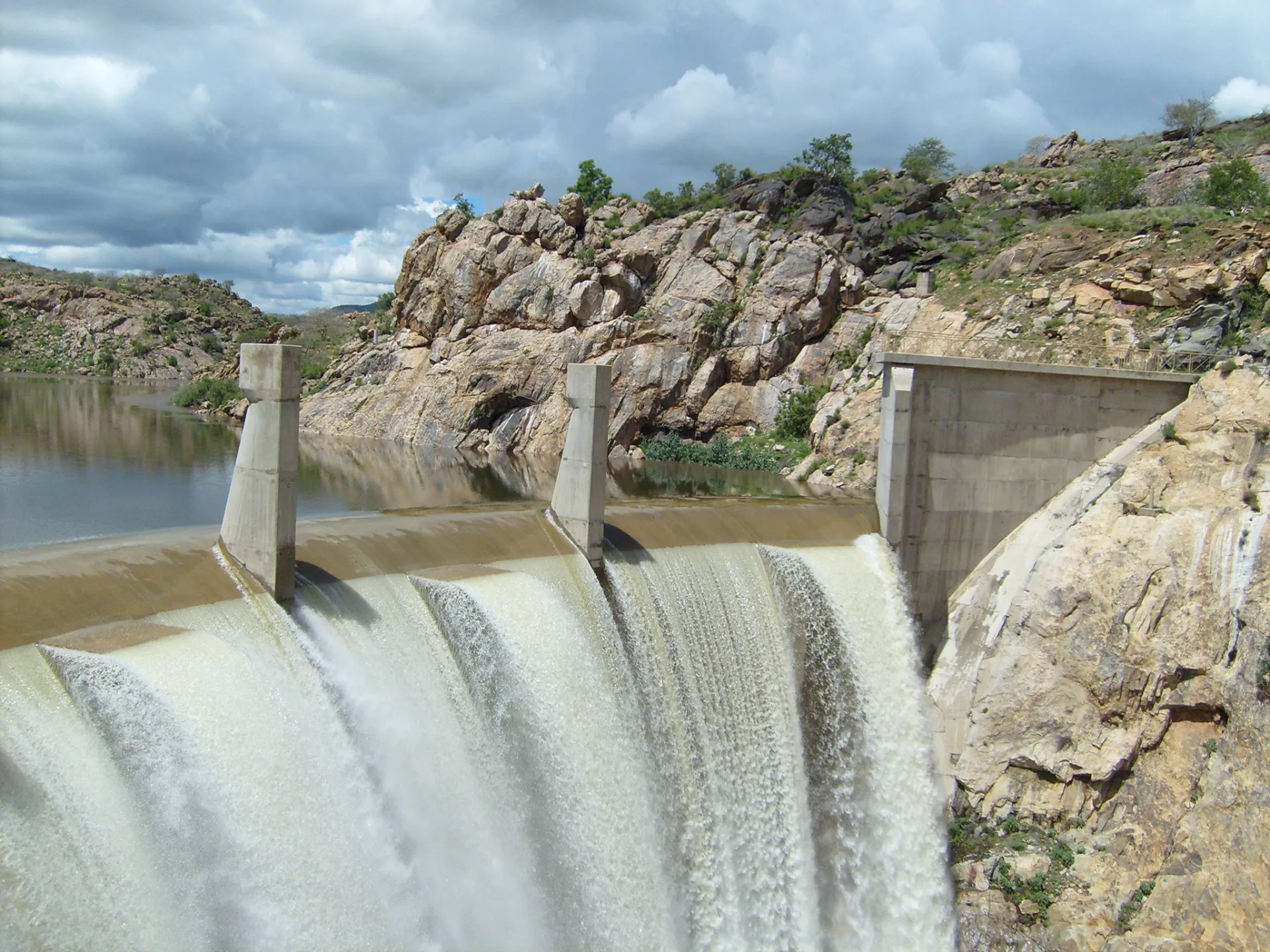
Namibia has 18 dams, most of them built on ephemeral rivers to capture and store water for dry periods. Seventeen are surface dams. The exception is Omdel (Omaruru Delta), which intercepts water and releases it to recharge the natural palaeochannel. Hardap Dam has a capacity of 294 million m³, and the Neckartal Dam is the largest in Namibia, with a capacity of about 857 million m³ according to the latest dam bulletin.
| Area | Dams |
|---|---|
| Central | Swakoppoort, Von Bach, Omatako, Friedenau, Goreangab, Kalkfeld, Omatjenne |
| Eastern | Otjivero Main, Otjivero Silt, Tilda Viljoen, Daan Viljoen |
| Southern | Hardap, Naute, Oanob, Dreihuk, Bondels, Neckartal |
| Northern | Olushandja |
| Western | Omdel |
Groundwater
In a country as dry as Namibia, surface water depends on rainfall that is extremely irregular in time and place. Floods are hard to manage, and in droughts surface water runs short. Groundwater is more reliable, more widespread and protected from evaporation: it can be abstracted in dry periods and is recharged in good rainy seasons.
More than 100 000 boreholes have been drilled over the past century to supply industry, towns, rural communities, livestock, game, irrigation and mines. Groundwater can supply even isolated communities and activities over nearly 80% of the country, and despite the cost of drilling, pumping and maintenance it is usually the most economical source.
Groundwater is unevenly distributed because it depends on the underlying rock. There are only a few places where large volumes can be abstracted sustainably, and in some areas the water is too poor in quality for human use, for example in the north-western Cuvelai-Etosha Basin and the south-eastern Stampriet Basin, known as the salt block.
Seawater Desalination
Plans for desalination on the central coast date back to 1996. Feasibility studies showed that desalinated water is a viable option for central coast customers, whose demand now exceeds the sustainable yield of the groundwater resources. NamWater has long wanted to build its own desalination plant, but costs and other challenges have so far prevented it, and plans are still under way.
The existing desalination plant on the coast is wholly owned by Orano Resources Namibia and operated by Aveng Water Treatment Namibia. It supplies NamWater with 12 million m³ a year, which NamWater sells to mines and industry outside the town lands. It has a short-term capacity of 20 million m³ a year, which can be increased to up to 45 million m³ a year in the medium to long term. The Erongo region's demand from communities and mines is about 20 million m³ a year, and consultants have been appointed for a KfW-sponsored feasibility study on future supply to the central coast, the central areas of Namibia and possibly Botswana.
Water Recycling
Namibia is a pioneer in direct potable reuse. The Goreangab Reclamation Plant in Windhoek has been producing drinking water from treated wastewater for decades, and Windhoek remains one of very few places in the world where sewage effluent is treated directly into potable water. After the International Water Association's 9th Water Reuse Conference, held in Windhoek in 2013, wastewater is increasingly seen as a valuable, reusable resource. The Government has also commissioned an engineering and environmental assessment of options to augment water supply to the central areas and the four northern regions.
Evaporation
Namibia's annual evaporation ranges from 2 600 mm in the north-east to 3 700 mm in the central south. Evaporation is highest from October to December, and dams can lose between 20% and 85% of their water to evaporation in one season.